Nio built a solar-only battery swap station in the Gobi Desert — no grid, no problem

Nio has switched on what it calls the world's first fully off-grid, zero-carbon battery swap station, located at the Xingxingxia service area in China's Xinjiang province. The station opened September 23, 2026, and runs entirely on solar power — no grid connection whatsoever. For anyone watching where EV charging infrastructure goes next, this is a meaningful data point: China is now stress-testing decentralized swap networks in conditions that would rule out any conventional approach.
The hardware keeping it alive
The Gobi Desert doesn't forgive bad engineering. Xingxingxia sees Force-8 winds on more than 100 days a year, surface temperatures hitting 70°C in summer, and -30°C in winter. Running a grid line hundreds of kilometres across the desert was never a serious option, so Nio partnered with LONGi — a deal signed in early 2024 — to deploy the LONGi BLOCK mobile energy station paired with LONGi H2D storage. During the day, photovoltaic panels power the station and charge the batteries. At night, stored energy takes over. If cloud cover lasts several days, the system automatically drops into an emergency mode that keeps only critical functions running. Liquid cooling handles the heat; three automatic operating modes handle everything else, per Gasgoo.
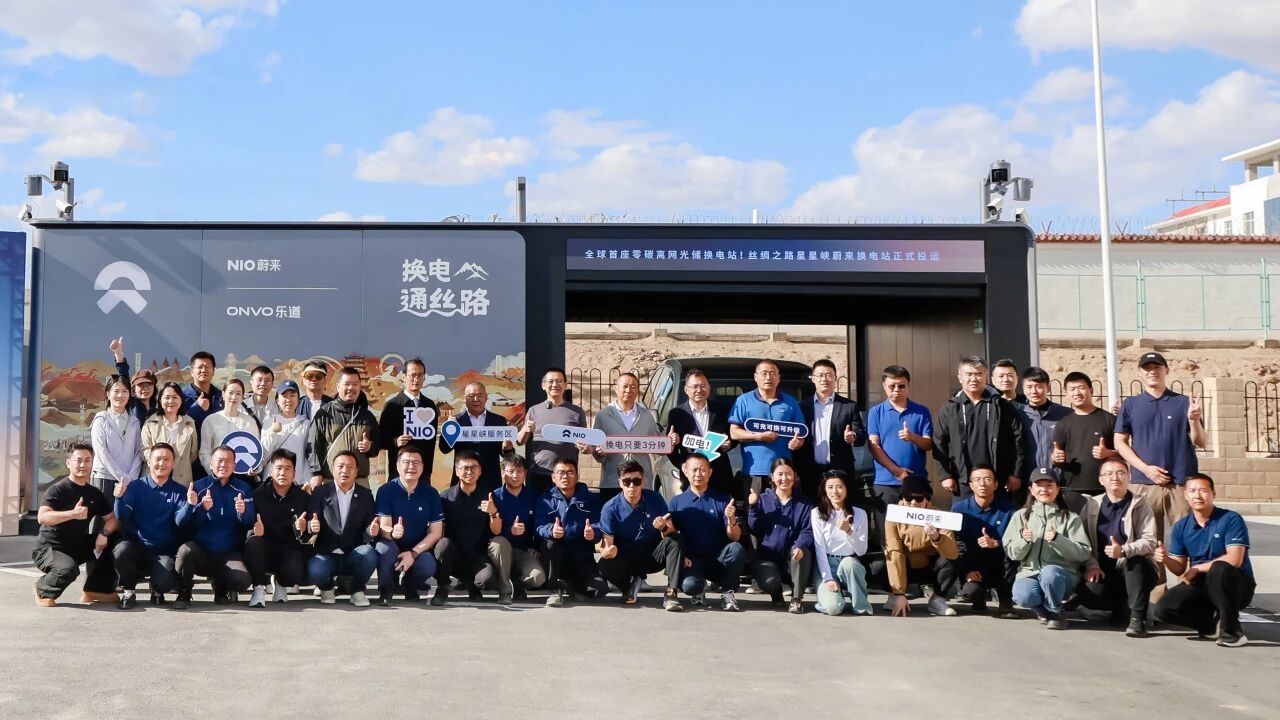
Nio's off-grid solar swap station at Xingxingxia, powered entirely by LONGi solar and storage hardware.
The bigger picture
This station isn't a standalone experiment. It's the flagship stop on Nio's "Silk Road" route — a 3,605 km corridor across western China that is scheduled to have all 33 of its swap stations operational by September 26, 2026, confirms CnEVPost. The network context matters: Nio now operates 4,109 battery swap stations across China (including 1,060 on highways) plus 5,301 charging stations — the largest swap network on the planet. The company hit its 100 millionth battery swap in February 2026, a scale no Western automaker is anywhere near replicating.
CEO Lihong Qin has positioned Xingxingxia as a blueprint for remote-area expansion, pointing to regions like Tibet and Xinjiang where grid extension is simply not viable. Electric Vehicles reports that the deployment is framed as a first validation — with further off-grid rollout contingent on what this station proves.
No Western equivalent on the horizon
Tesla, Ionity, and legacy OEMs have focused on fast-charging hubs tied to existing grids. Nobody in the US, UK, or EU is developing off-grid battery swap infrastructure at this scale or in these conditions. Nio's approach ties EV access to areas that grids simply don't reach — a competitive angle that doesn't yet have a Western counterpart. There are no announced plans to bring this technology to Europe or North America.


